The BRRRR Strategy in Des Moines: Does It Still Work in 2026?
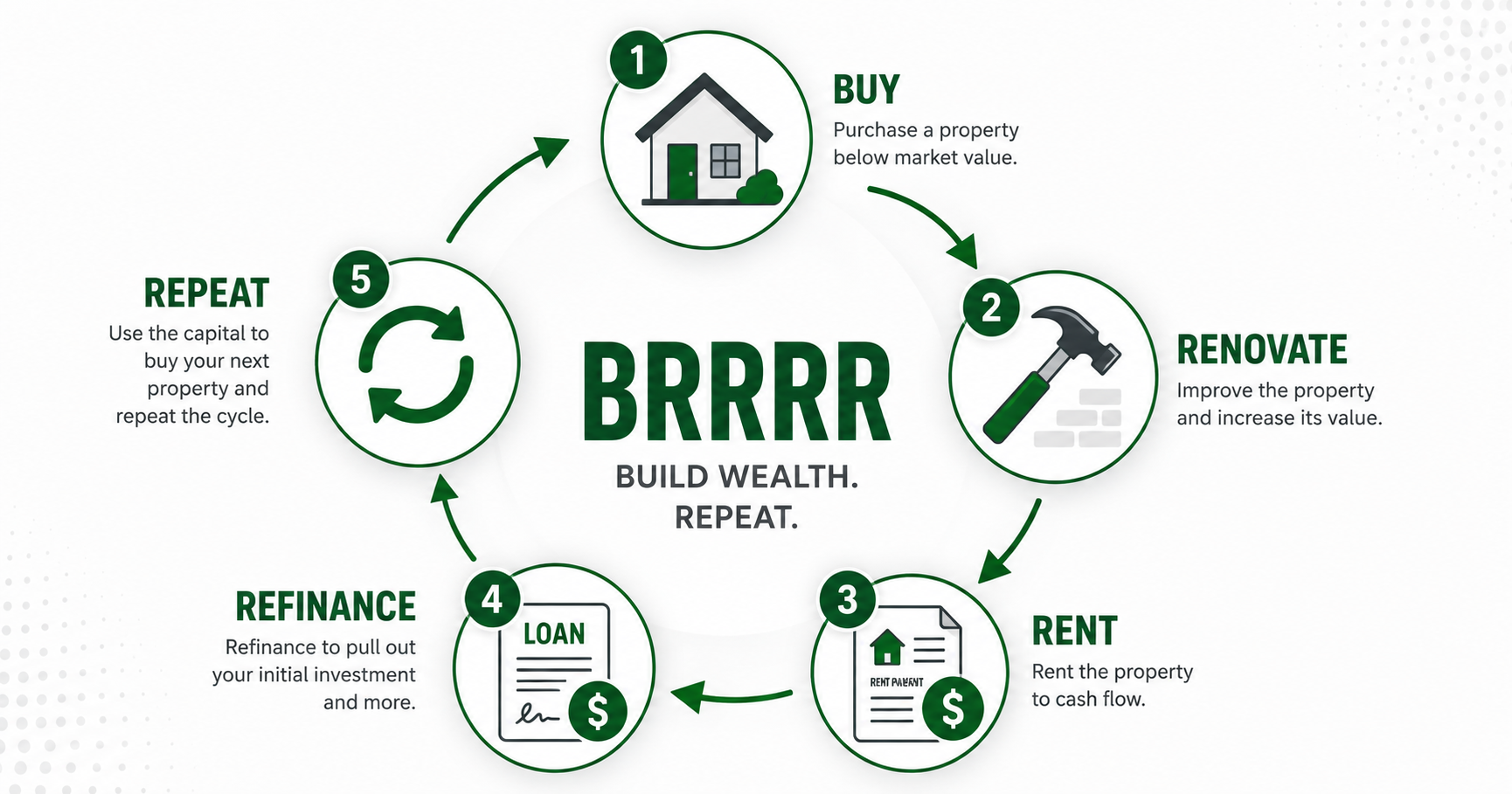
The BRRRR strategy — Buy, Renovate, Rent, Refinance, Repeat — has been one of the most talked-about frameworks in real estate investing over the past decade. The idea is straightforward: buy a distressed property below market value, force appreciation through renovation, rent it out, refinance based on the new appraised value to pull out most or all of your initial capital, then redeploy that capital into the next deal.
In theory, it's a powerful wealth-building engine. In practice, it requires the right market conditions to work. The question for Des Moines investors in 2026 is: does this market support it?
The short answer is yes — with discipline.
What BRRRR Requires to Work
Before running the numbers, it's worth being clear on what has to be true for BRRRR to work:
You can buy significantly below market value. BRRRR only creates real equity recycling if the acquisition price plus renovation cost is meaningfully less than the post-renovation appraised value.
Rents are strong enough to carry the refinanced debt. After you refinance, the rent needs to cover the new (higher) mortgage payment and still generate positive cash flow.
Refinance rates are manageable. In a high-rate environment, pulling cash out at 7–8% interest eats into your cash flow significantly.
You can find deals. Value-add properties don't list on the MLS at acquisition prices. Finding them takes effort.
Des Moines currently satisfies conditions one, two, and four reasonably well. Condition three is the tightest variable in 2026.
The Des Moines Market in BRRRR Terms
Home Price Appreciation
Q1 2026 saw median prices rise 6.2% year-over-year across the metro. Ankeny hit 7.8%, West Des Moines 8.1%. This matters for BRRRR because it means the gap between distressed and renovated values is real and growing — a property bought at $180,000 that appraises at $240,000 post-renovation has $60,000 in forced equity to work with.
Rent Growth
At 2.8% projected annually, Des Moines rents are growing enough to incrementally improve cash flow on refinanced assets over time. Average two-bedroom rents around $1,100/month provide a workable income base for deals in the $180,000–$250,000 range.
Value-Add Inventory
Established Des Moines neighborhoods — Beaverdale, Merle Hay, Drake, South Side — still have a meaningful supply of older housing stock that can be acquired below replacement cost and repositioned. Central Des Moines averages $142/square foot vs. $165–$185 in the suburbs — that gap creates room for forced appreciation plays.
The Refinance Challenge
30-year refinance rates in the 7% range are the tightest variable in the BRRRR equation right now. Pulling cash out at 7% means your refinanced mortgage payment is meaningfully higher than it would have been in 2020–2021. The strategy works, but the numbers need more cushion than they did when rates were at 3–4%.
A Real BRRRR Example for Des Moines
Let's walk through a deal that could work in the current environment.
The Acquisition
Distressed duplex in a stable Des Moines neighborhood
Purchase price: $155,000
Renovation budget: $45,000 (new roof, HVAC, kitchen/bath updates, paint, flooring)
Total invested: $200,000 (purchase + renovation + closing costs)
Post-Renovation
Appraised value: $255,000
Two units at $1,050/month each = $2,100/month gross rent
Annual gross rent: $25,200
The Refinance
Cash-out refinance at 75% LTV: $191,250
At 7% over 30 years: ~$1,273/month ($15,276/year)
Capital returned: $191,250 – original $200,000 out-of-pocket = you still have ~$8,750 in the deal
The Ongoing Cash Flow
Gross annual rent: $25,200
Vacancy (6%): –$1,512
Operating expenses (taxes, insurance, maintenance, management): –$7,200
NOI: $16,488
Annual debt service: $15,276
Annual cash flow: $1,212
The Verdict
Cash flow is thin at current rates — roughly $100/month. This deal wouldn't have been worth doing in 2020 at these cash flow levels.
In 2026, the calculus is different: the $255,000 asset appreciating at even 5% annually adds $12,750 in equity per year. Principal paydown on the mortgage adds another $3,000–$4,000 per year in the early years. The total return — cash flow + appreciation + principal paydown — is compelling even if the monthly cash flow alone looks modest.
And if rates drop even 1%, the monthly payment drops by roughly $130 — turning a thin deal into a solid one.
Where to Find BRRRR Deals in Des Moines
BRRRR deals don't come to you. You have to build the pipeline. The most productive sources in the Des Moines market:
Direct mail to distressed owners — tax-delinquent properties, probate properties, out-of-state owners
Relationships with contractors — trades who work on distressed properties often know owners who are motivated to sell
Wholesalers — there's an active wholesaler community in Des Moines; the challenge is that their margins leave less room for your renovation and profit
Driving for dollars — identifying visually distressed properties in target neighborhoods
Networking with estate attorneys and CPAs — executors and heirs of properties often want a quick, clean sale
The best BRRRR investors in Des Moines build deal flow pipelines. The ones who wait for MLS opportunities generally don't find the numbers they need.
The Critical Factor: Accurate After-Repair Value
The entire BRRRR equation hinges on accurately predicting what the property will appraise for after renovation. Overestimating the ARV is the most common and most expensive mistake investors make.
Ways to Protect Yourself
Get a pre-purchase opinion from a local appraiser or agent, not just a Zestimate
Pull your own comps conservatively — use the bottom third of the range, not the top
Talk to local real estate agents about what post-renovation properties actually sell and appraise for in that specific neighborhood
Build in a 20% buffer on renovation costs — they almost always run over
The Bottom Line
BRRRR still works in Des Moines in 2026 — but the margin for error is tighter than it was two years ago. Deals need to be bought at a deeper discount, renovations need to be executed efficiently, and cash flow expectations need to be realistic in a 7% rate environment.
The investors who will succeed with this strategy in the current market are the ones who underwrite conservatively, build real deal flow pipelines, and have genuine operational execution — not just a good spreadsheet.
If you're working through a BRRRR deal in Des Moines and want a second opinion on the numbers — or a management partner who can execute the rental side when you're ready to refinance — Grassroots can help.
Book a free consultation:
Schedule a Consultation